

What are the application scenarios for electric pallet trucks and reach trucks?
Release time: 2026-08-18
In warehousing and logistics operations, “handling goods” and “high-level storage and retrieval” may seem like the same task, but their actual equipment requirements differ significantly. Electric pallet trucks emphasize flexible and efficient horizontal handling, suitable for frequent short-distance transfers of palletized goods; reach trucks, with their mast-moving and high-lifting capabilities, are more suitable for rack storage and high-density warehousing environments. When companies face different conditions such as warehouse aisles, rack height, goods weight, and operating frequency, which type of equipment should they choose? This article will provide a detailed analysis of electric pallet trucks and reach trucks from the aspects of working methods, typical application scenarios, equipment characteristics, and actual selection, helping companies more accurately match their material handling needs.
I. What are the main application scenarios for electric pallet trucks?
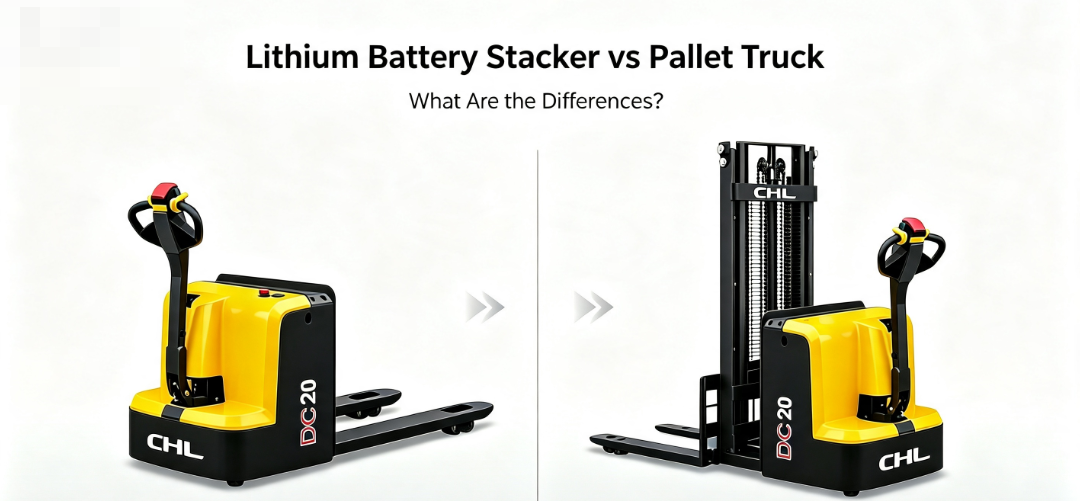
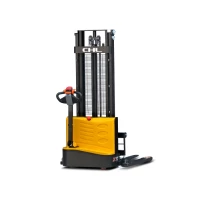
The core function of an electric pallet truck is the horizontal handling of palletized goods. The equipment typically uses batteries as a power source, with an electric motor driving the vehicle and a hydraulic system for raising and lowering the forks.
1. Short-distance transport within warehouses
In typical warehouses, goods frequently need to be moved from the receiving area to the storage area, or from the storage area to the shipping area. For tasks that don’t require high-level stacking, electric pallet trucks offer a more flexible handling method.
Especially when the transport distance is short and the number of pallets is large, electric pallet trucks can reduce manual pushing and pulling, improving daily logistics efficiency.
2. Material distribution in production workshops
Manufacturing companies typically need to distribute raw materials, components, or semi-finished products from warehouses to production lines. Electric pallet trucks, with their relatively compact bodies, can move frequently within production workshops and logistics channels.
For industries such as electronics, machinery, food, and beverage, this equipment is suitable for handling internal material turnover between production lines.
3. Logistics distribution centers
Logistics centers handle a large number of palletized goods daily. Electric pallet trucks can be used for vehicle loading and unloading, short-distance transfers between platforms and warehouses, and pallet handling in inbound and outbound processes.
If the focus of the operation is on rapid movement of goods rather than high-level stacking, electric pallet trucks are generally more suitable.
II. What are the main scenarios where reach trucks are suitable?
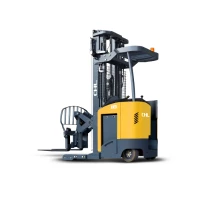
Reach trucks are also electrically powered, but their design focuses differ significantly from electric pallet trucks. Equipped with a mast reach mechanism, reach trucks allow the forks and goods to extend or retract forward, making them ideal for high-level storage and retrieval operations in racking areas.
1. High-bay racking warehouses
This is the most typical application scenario for reach trucks.
Modern warehousing companies often increase racking height to improve warehouse space utilization. Reach trucks can lift goods to higher positions and perform pallet retrieval, making them particularly suitable for high-bay racking warehouses.
2. Narrow aisle storage environments
Compared to some large counterbalance forklifts, reach trucks are better suited for relatively narrow aisle environments within warehouses.
If a company wants to increase racking density within a limited warehouse area, reach trucks can help improve space utilization through their superior maneuverability.
3. High-Turnover Logistics Warehousing
For large logistics centers, e-commerce warehouses, third-party logistics providers, and distribution centers, goods not only need to be moved horizontally but also frequently accessed between racks of different heights.
These scenarios place higher demands on the lifting height, operational stability, driving efficiency, and operator visibility of the equipment. Therefore, reach trucks are generally more suitable than ordinary electric pallet trucks.
III. What are the differences between electric pallet trucks and reach trucks?
Although both are electric material handling equipment, they can be distinguished from several key dimensions:
| Comparison Item | Electric Pallet Truck | Reach Truck |
| Primary Function | Horizontal pallet handling and short-distance transportation | High-level pallet storage, retrieval, and material handling |
| Typical Working Areas | Warehouse floors, loading docks, staging areas, and transport aisles | High-bay warehouses, pallet racking areas, and narrow aisles |
| Lifting Requirement | Low lifting height, mainly for pallet entry and ground-level handling | High lifting capability for accessing elevated storage positions |
| Racking Operations | Generally not designed for high-level racking | Specifically designed for pallet storage and retrieval from racks |
| Maneuverability | Highly maneuverable for short-distance and frequent pallet movement | Designed for efficient operation in narrow warehouse aisles |
| Typical Applications | Warehouses, manufacturing facilities, distribution centers, and loading areas | High-bay warehouses, logistics centers, distribution hubs, and high-density storage facilities |
If a company primarily needs to “move goods from point A to point B,” electric pallet trucks are preferable; if a company needs to “move palletized goods to high racks,” reach trucks are more suitable.
IV. How to choose during actual procurement?
Equipment selection should not be based solely on the product name but also on the actual working conditions.
First, the weight of the goods and the size of the pallets need to be confirmed. If the goods are heavy, equipment with a rated load that meets the actual needs should be selected, and long-term overloading should be avoided.
Second, the width of the warehouse aisles needs to be measured. If the warehouse uses a high-density racking layout with limited aisle space, the equipment’s dimensions, turning radius, and operational flexibility should be the primary focus.
Third, the racking height needs to be clearly defined. If goods are mainly stored on the ground or in low-level areas, electric pallet trucks can meet most handling needs; however, if there are higher racking access requirements, the lifting height and load capacity of reach trucks should be the main considerations.
Finally, daily operating hours, handling distances, battery capacity, charging conditions, and maintenance costs also need to be considered. For companies with high-frequency continuous operations, the equipment’s battery performance and overall durability are equally important.
Fifth, is it necessary to configure both types of equipment simultaneously?
For medium to large-sized warehouses, electric pallet trucks and reach trucks are not substitutes but complements each other.
For example, in a complete warehousing process, electric pallet trucks can handle horizontal transport between receiving and shipping areas and within the warehouse, while reach trucks can handle high-level racking access and stacking.
This equipment combination allows different equipment to perform their respective tasks, thereby reducing equipment idle time and improving the overall operational efficiency of the warehousing system.
There is no absolute superiority or inferiority between electric pallet trucks and reach trucks; the key lies in whether the equipment truly matches the company’s operating environment. For scenarios primarily involving ground handling, short-distance transfers, and vehicle loading and unloading, electric pallet trucks offer flexible and efficient solutions. Reach trucks are more advantageous for high-bay racking, narrow aisle, and high-density storage environments. For medium to large-sized warehouses with more complex operational processes, both types of equipment can be rationally configured according to different stages, allowing horizontal handling and high-bay storage to each perform their respective functions. Ultimately, companies should comprehensively evaluate multiple dimensions, including goods, pallets, aisles, racking, operational intensity, and long-term operating costs, rather than simply making decisions based on equipment parameters or purchase price.