

How Narrow Aisle Forklifts Improve Space Utilization in Warehouses
Release time: 2026-01-26
In today’s rapidly developing logistics industry, the efficient utilization of warehouse space is crucial for improving operational efficiency. Narrow aisle forklifts, as specially designed material handling equipment, leverage their flexibility and efficiency to achieve higher storage density within limited space. By optimizing warehouse layout and improving goods access efficiency, narrow aisle forklifts provide innovative solutions for businesses, helping them stand out in fierce market competition.
I. Main Advantages of Narrow Aisle Forklifts
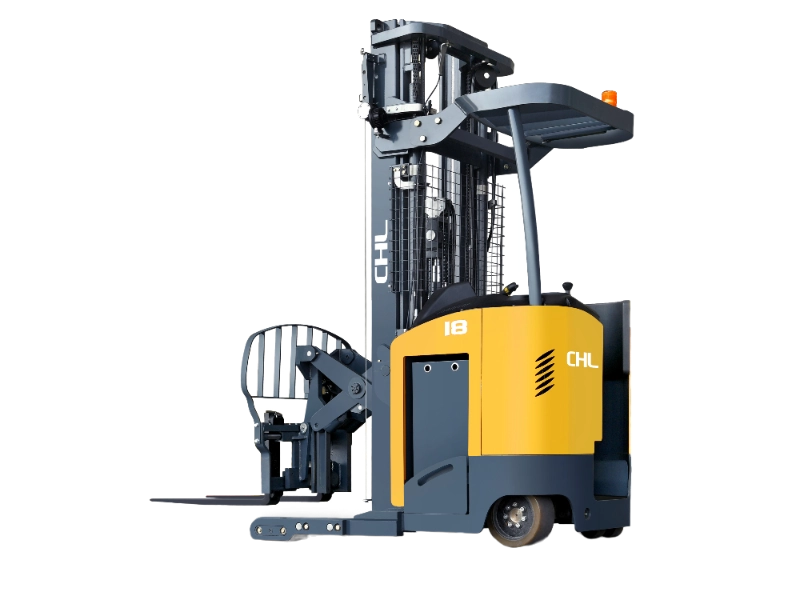
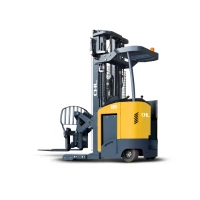
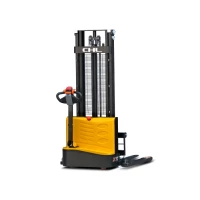
The biggest advantage of very narrow aisle forklifts is their smaller turning radius and efficient cargo handling capabilities. Compared to traditional forklifts, narrow aisle forklifts can operate in narrower aisles, allowing for a more compact warehouse design. Typically, narrow aisle forklifts can operate in aisles as narrow as 1.6 meters wide, while conventional forklifts require wider aisles. In addition, narrow aisle forklifts usually use electric drive systems, offering the advantages of low noise and zero emissions, contributing to a better warehouse working environment.
Another significant advantage is their lifting height. Narrow aisle forklifts can typically stack goods to higher positions, thus reducing the floor space occupied. This allows warehouses to increase storage capacity by utilizing vertical space, thereby improving overall space utilization efficiency.
II. Key Applications of Narrow Aisle Forklifts in Narrow Spaces
Narrow aisle forklifts are particularly suitable for environments with limited space but requiring efficient operations. For example, in industries such as food processing, pharmaceuticals, and electronics, warehouses often need to store a large number of products while maintaining efficient picking and transportation processes. Narrow aisle forklifts can be flexibly applied in these industries, freeing up more storage space by minimizing aisle widths.
Furthermore, narrow aisle forklifts are also suitable for multi-level warehouse operations. In multi-level racking systems, forklifts can access and retrieve goods at elevated positions without worrying about operational difficulties due to insufficient space. This efficient access method not only improves work efficiency but also ensures the accuracy and safety of inventory.
III. How Narrow Aisle Forklifts Improve Warehouse Space Utilization
Firstly, narrow aisle forklifts improve the storage density of goods by optimizing the warehouse layout. By using narrow aisle forklifts, warehouse managers can reduce the distance between shelves, increase the number of storage layers on each shelf, and thus increase overall storage capacity. For example, a passage that previously required a 3-meter width can now be reduced to 1.6 meters to meet operational needs, thus freeing up space for more goods.
Secondly, the efficient operation of narrow-aisle forklifts reduces access time, thereby increasing warehouse turnover. Efficient material handling speed means that more orders can be processed in the same amount of time, further reducing pressure on warehouse space.
Finally, the advanced technologies equipped in narrow-aisle forklifts, such as laser navigation and autonomous driving functions, enable more efficient cargo management. These technologies not only improve operational safety and accuracy but also reduce human error, making warehouse management more intelligent and further optimizing space utilization.
Narrow-aisle forklifts, with their unique advantages, significantly improve warehouse space utilization and help businesses achieve more efficient logistics management. By rationally utilizing this equipment, you can not only optimize warehouse layout but also improve work efficiency, bringing considerable economic benefits to your business. Choose CHL, let’s create a smarter warehousing future together.