

45 Ton Reach Stacker for Ports: Key Benefits and Applications
Release time: 2026-08-05
In port logistics and container transportation, the efficiency of handling equipment directly affects container turnover rates and overall logistics costs. With the development of large container terminals, inland ports, and intermodal logistics centers, conventional forklifts may no longer meet the requirements of certain heavy-duty container handling operations in terms of lifting capacity, operating height, and stacking efficiency.
As heavy-duty equipment specifically designed for container handling, the 45-ton reach stacker offers high lifting capacity, a telescopic boom, and excellent mobility. It can perform a variety of tasks, including container loading and unloading, stacking, and short-distance yard transportation. As a result, 45-ton reach stackers have become important material handling equipment for certain ports, container yards, and logistics centers.
This article explores the key advantages and typical applications of 45-ton reach stackers in port operations based on actual port handling requirements.
What Is a 45-Ton Reach Stacker?
A 45-ton reach stacker, also known as a 45-ton container reach stacker, is a heavy-duty material handling machine designed for container lifting, transportation, and stacking. It typically consists of a heavy-duty chassis, engine, hydraulic system, telescopic boom, and container spreader.
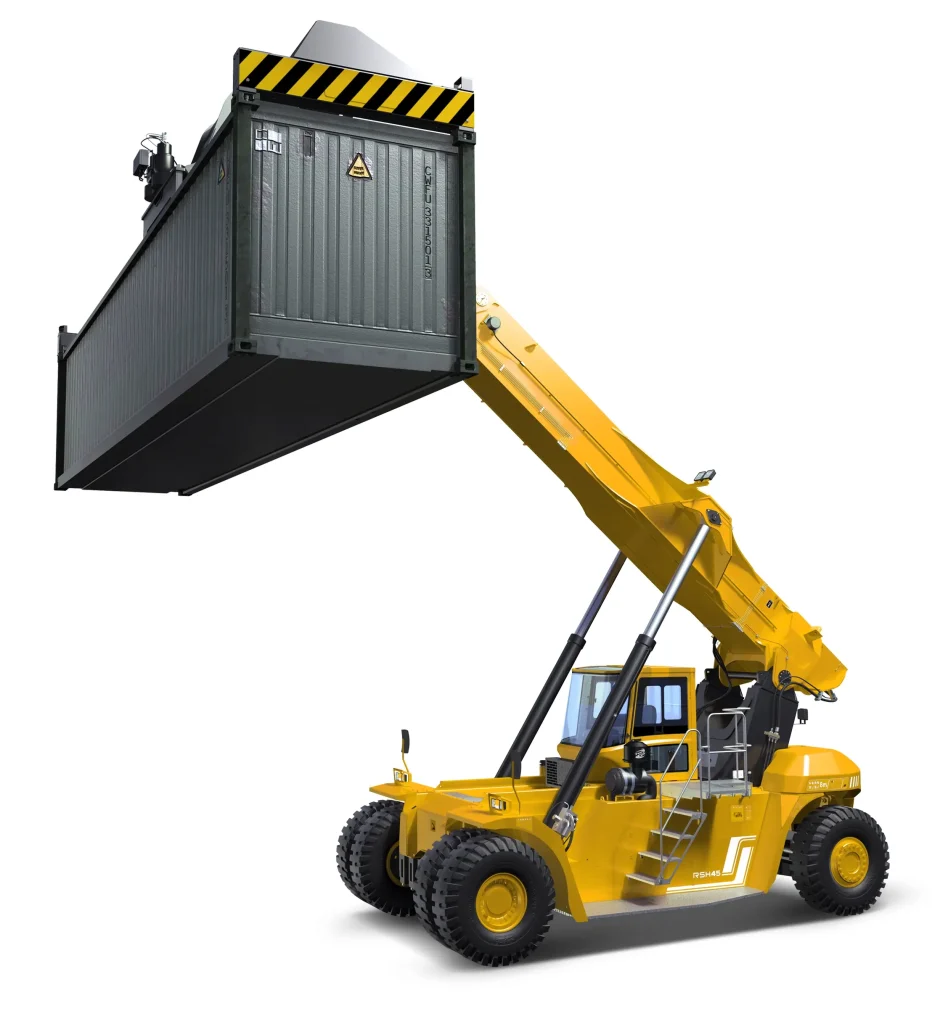
Unlike conventional forklifts, which use forks to support loads, a reach stacker uses a container spreader to connect with the corner castings of a container. The telescopic boom then lifts, transports, and positions the container as required.
Key Advantages of 45-Ton Reach Stackers in Port Operations
1. High Lifting Capacity for Heavy Container Handling
Container weights vary considerably in port operations, particularly when transporting machinery, engineering equipment, minerals, and other heavy cargo.
A 45-ton reach stacker features a heavy-duty chassis, telescopic boom, and high-load-bearing structure, allowing it to handle heavy containers and other high-load materials.
For ports and logistics companies that regularly handle heavy containers, selecting a suitable 45-ton reach stacker can reduce operational limitations caused by insufficient lifting capacity.
2. Greater Operational Flexibility with a Telescopic Boom
One of the key structural features of a reach stacker is its telescopic boom.
The boom can extend, retract, and lift, allowing the machine to pick up and position containers from different locations. This makes the equipment particularly suitable for container yards where containers need to be frequently repositioned or stacked.
Compared with fixed container handling equipment, reach stackers offer greater mobility and operational flexibility. They can move between different work areas according to actual port requirements.
3. Efficient Container Stacking
For ports and container yards, land and storage space are valuable resources. Improving the use of vertical storage space is an important way to increase yard efficiency.
A 45-ton reach stacker can use its telescopic boom to lift containers to the required height and stack them in multiple layers, depending on the machine model and configuration, .it can meet the container storage needs of most container yards.
Therefore, a heavy-duty reach stacker is not only used for container transportation but can also play an important role in optimizing container yard space.
4. Excellent Mobility for Different Work Areas
A typical port may include container handling areas, storage yards, truck lanes, and transfer zones, each with different operational requirements.
A reach stacker uses a wheeled chassis and can travel independently within the port without relying on fixed rails. This mobility is particularly useful when containers need to be transferred between multiple work areas.
For operations involving frequent short-distance container transportation, the mobility of a reach stacker can help improve overall equipment utilization.
5. One Machine for Multiple Handling Tasks
A 45-ton reach stacker can be used not only for container stacking but also for container loading and unloading, short-distance transportation, truck loading and unloading, and yard transfer operations.
This multifunctional capability allows one machine to support several stages of the logistics process. For small and medium-sized ports, inland container yards, and intermodal logistics centers, it can help reduce equipment changes between different handling operations and improve workflow efficiency.
Main Applications of 45-Ton Reach Stackers
1. Port Container Terminals
Port container terminals are one of the major application areas for 45-ton reach stackers.
During container handling operations, reach stackers can work together with container trucks, trailers, and other port handling equipment to transfer containers between transportation vehicles and storage yards.
For ports handling heavy containers, a 45-ton reach stacker provides high load capacity and can adapt to demanding container handling operations.
2. Container Yards
Container yards require frequent container transportation, repositioning, and stacking.
A 45-ton reach stacker can lift containers from trucks, transport them to designated locations, and stack them according to the yard layout. When containers need to be repositioned or dispatched, the reach stacker can also relocate them efficiently.
As a result, reach stackers are particularly suitable for small and medium-sized container yards and logistics facilities that require high operational flexibility.
3. Railway Container Terminals
With the development of rail freight and intermodal transportation, railway container terminals require efficient equipment for transferring containers between road and rail transportation.
A 45-ton reach stacker can handle container loading and unloading, stacking, and short-distance transportation, enabling containers to be transferred efficiently between rail vehicles, trucks, and storage yards.
For intermodal rail-road logistics projects, reach stackers can serve as important container handling equipment and improve the efficiency of the transfer process.
4. Inland Ports and Logistics Centers
Inland ports play an important role in connecting seaports with inland transportation networks. They often need to handle large volumes of containers for temporary storage, transfer, and distribution.
In these applications, a 45-ton container reach stacker can be used for container stacking, truck loading and unloading, and yard transportation, providing flexible handling capabilities for inland logistics centers.
5. Intermodal Logistics Centers
Modern supply chains often involve multiple transportation modes, including ocean, rail, and road transportation. Intermodal logistics centers need efficient equipment to transfer containers between these different modes.
Reach stackers can provide an important connection between different transportation stages, such as transferring containers between trucks and rail vehicles, helping reduce handling time and improve overall logistics efficiency.
Conclusion
As port container transportation continues to evolve toward higher efficiency, heavier loads, and greater integration of multimodal transportation, 45-ton reach stackers are becoming increasingly valuable for heavy-duty container handling.
From port terminals and container yards to railway freight yards and inland logistics centers, 45-ton reach stackers can perform a wide range of tasks, including container loading and unloading, stacking, and yard transportation. If you are looking for a 45-ton reach stacker for port, container yard, or intermodal logistics applications, CHL Forklift can provide suitable equipment and material handling solutions based on your specific operational requirements.